

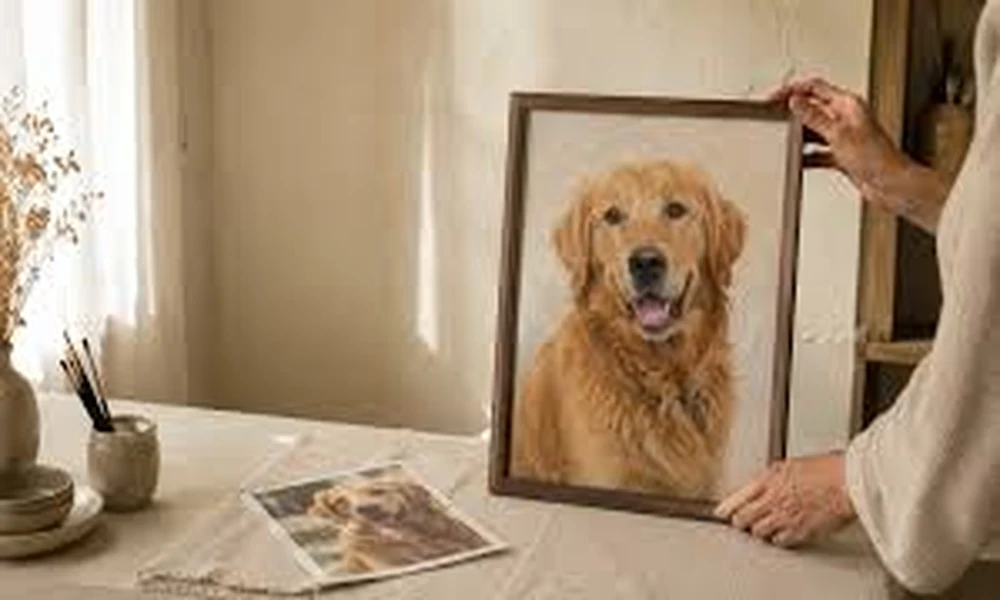
You may want to give a friend a portrait after their pet dies because you remember how much that animal mattered. It is a personal idea, but several decisions belong to your friend: whether they want artwork now, which photograph feels right, and whether they want a visible reminder in their home.
A memorial pet portrait can be offered without becoming an unrequested project. Start with permission and leave room for a different answer than the one you hoped to hear. The aim is to acknowledge a particular animal and relationship, not to prescribe how the recipient should remember them.
Ask whether a portrait would be welcome
You can make the offer plainly: “I would like to arrange a portrait of your pet, if that is something you would want. There is no need to decide now.” This explains the idea and removes the expectation of an immediate response.
Avoid presenting a finished large piece before you know how the recipient feels about it. They may appreciate your intention while finding the object difficult to receive or display. Asking first allows them to choose a photograph, a smaller format, a later time, or no portrait at all.
Cornell University’s pet loss resources emphasize that responses to loss differ and that grief does not follow a prescribed timeline. That is a reason to avoid selecting a gift date according to assumptions about when someone should be ready.
Keep the offer separate from promises about emotional results. A portrait is not a treatment, and you cannot know whether receiving one will bring comfort. You can offer care and choice without predicting how the person will feel.
Let the recipient choose the remembered moment
If your friend wants the portrait, invite them to identify the photograph or period they prefer. They might choose a young pet, a familiar adult expression, or an ordinary moment from later life. Your favorite image may not represent the memory they want to keep.
Do not assume the last photograph is the appropriate one. Likewise, do not quietly replace an older appearance with a younger one because you think it looks more cheerful. Ask which version should guide the artwork.
You can help locate the original file if your friend wants assistance. Organize any additional images by purpose, such as showing a marking more clearly. Give the portrait maker one main reference instead of an unexplained collection from different years.
Pet portraits from photos work as a personal project when the visual decisions follow the recipient’s preferences. The photograph does not have to communicate a complete life story. One familiar face can remain the subject while other memories stay in an album or conversation.
Do not invent wording for the artwork
Names, dates, and inscriptions deserve their own check. Ask whether the recipient wants text included and whether the selected product supports it. A portrait without an inscription may be exactly what they prefer.
If wording is requested, use confirmed information. Check the pet’s name, any nickname, and the spelling your friend uses. Do not invent a birth date when an adoption date is the only known date, or turn an approximate year into a precise one.
Be careful with religious language, statements about an afterlife, or phrases about moving on. You may find a sentiment reassuring without knowing whether it reflects the recipient’s beliefs. A short personal note about an actual memory can be more appropriate than assigning a universal message to the artwork.
Keep your account of the animal specific and honest. Mention the greeting you remember or a moment you shared. Avoid writing a fictional message from the pet or making claims about what the animal would want the owner to do.
Choose the physical piece with the recipient
Confirm whether your friend wants a physical portrait and where they might keep it. A large wall piece and a small privately viewed image require different amounts of space and attention. Neither is inherently the more meaningful choice.
Allow the recipient to choose a restrained presentation if that suits them. Do not add memorial symbols simply because the occasion is a loss. The portrait can look like an ordinary picture of an animal they loved.
Pet portrait options from Pawfolio Art offer a place to explore different presentations of a pet photograph. Review the selected product’s current format, size, and customization options together. Browsing examples should not become pressure to order immediately.
For someone who wants to understand the physical differences before choosing, the guide to Art Print and Canvas formats can clarify that decision. Keep the discussion practical and let your friend decide what they want to have in their home.
Offer help with the process rather than taking control
You can make the commission easier by handling administrative details your friend wants you to manage. Ask whether they would prefer to submit the photograph themselves, review an included proof, or have you consolidate the notes. Do not assume they want every step delegated.
If you review artwork on their behalf, keep the criteria limited to the choices they approved. A visible marking or confirmed name can be checked against a reference. Changing the expression, scene, or remembered period calls for their input.
Send one organized set of revision notes when changes are needed. Identify the specific feature and the reference that supports the correction. Avoid involving many people whose different preferences could override the recipient’s own choice.
Make the purchase boundary clear as well. Check current production, delivery, and custom-order policies before committing, and do not promise an arrival date you cannot guarantee. Your friend should not inherit confusion about an order you arranged for them.
Give the artwork without requiring a public response
Ask where and how the recipient would like to receive the piece. A private handoff may be preferable to opening it during a group gathering. Do not record the moment or share the image publicly without permission.
Let your friend decide when to display it. Keeping a portrait in its packaging for a while does not tell you whether the gift is valued. There is no need to ask for a photograph of it hanging on the wall or to seek a particular emotional reaction.
If they decline the idea, accept that answer without offering increasingly different versions of the same gift. You can still send a thoughtful note or offer another kind of help they actually want. Permission should remain a real choice rather than the first stage of persuasion.
A custom pet portrait offered after a loss should leave the recipient in charge of the memory, the timing, and the object. Ask first, use confirmed details, and keep the handoff private if that is their preference. Those decisions make your intention clear without assigning the gift a role it cannot promise to fulfill.