

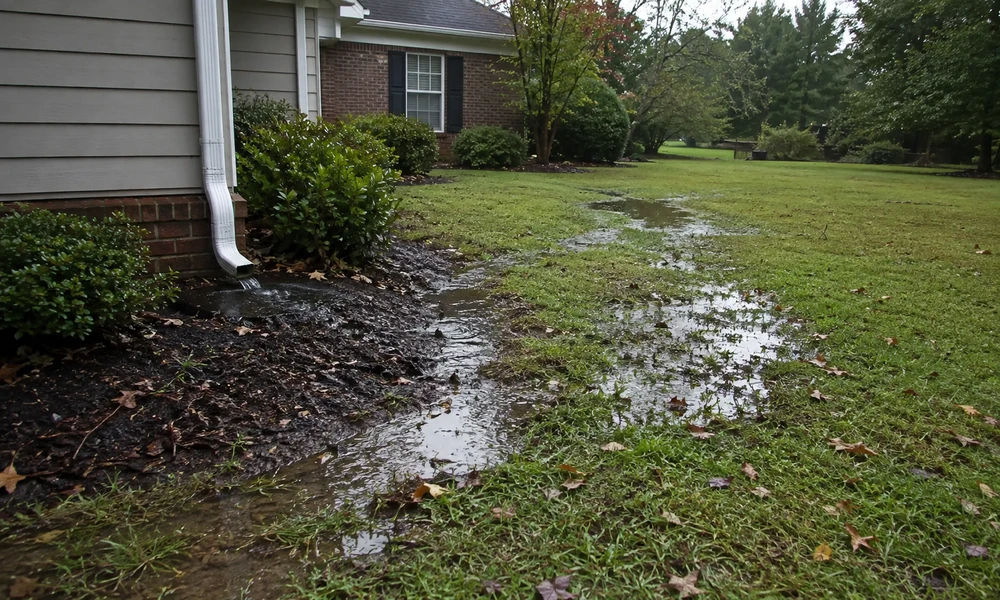
Most homeowners inspect their roofs, gutters, and drainage systems when something obviously breaks. A better opportunity often comes immediately after a steady rain.
Once the weather clears, the path that roof runoff took across the property can reveal clogged outlets, leaking connections, damaged downspouts, poor discharge locations, and landscape drainage problems that may otherwise remain unnoticed.
The goal is not simply to find standing water. It is to trace where the water came from, where it was supposed to go, and where that drainage path stopped working correctly.
Start Where the Water Leaves the Roof
Begin by looking at the ground beneath the roofline and around each downspout.
A properly functioning gutter-and-downspout system collects water from the roof and directs it toward a controlled discharge point. When that path is interrupted, the surrounding property may provide visible clues.
Look for unusually wet soil directly beneath a gutter, splash marks on siding, washed-out mulch, small channels through landscaping, or areas where soil has moved. Water appearing beneath the middle of a gutter run, for example, suggests a different issue from water accumulating near the bottom of a downspout.
Also inspect gutter-to-downspout connections from ground level. A connection that drips heavily during rain can send water down the exterior wall rather than through the intended drainage path.
Government building guidance emphasizes that roof runoff should be managed so that it does not simply saturate the soil immediately surrounding a building.
Follow Each Downspout to Its Discharge Point
Next, examine where each downspout actually sends the water.
A downspout can be completely open and still create a drainage problem if it releases water in an unsuitable location. Watch for concentrated runoff heading back toward the building, collecting beside hardscape, cutting channels through a garden bed, or immediately flowing across a driveway or walkway.
The discharge area matters because the downspout is only one part of the overall water-management system. Extensions, grading, landscaping, swales, rain gardens, or other drainage features may determine what happens to water after it leaves the pipe.
Purdue Extension notes that downspout runoff can, where appropriate, be redirected toward lawns, landscaping, rain gardens, porous surfaces, or rainwater collection rather than simply being discharged onto hard surfaces. The correct option depends on the property and local conditions.
When inspecting the area, therefore, ask two separate questions: Is water moving freely through the downspout, and is it being released somewhere that can handle it?
When the Downspout Itself Is the Problem
Some warning signs point more directly to the downspout than to the surrounding landscape.
Look for separated joints, crushed sections, holes, visible corrosion, loose fasteners, or sections that have pulled away from the wall. During rainfall, water escaping from a joint midway down the pipe is another useful clue. Repeated overflow at the top may indicate debris or a restriction that deserves further investigation.
A minor connection problem may be repairable, while extensive corrosion or physical damage can make replacement more practical. The right answer depends on the condition of the existing components and whether they can still move water reliably.
If the source of the failure is unclear, searching for downspout repair near me can help homeowners find a local professional who can determine whether the affected section needs a straightforward repair, adjustment, or replacement rather than repeatedly treating the visible symptom.
That distinction is important. Clearing debris will not solve a split pipe, and replacing a sound downspout will not correct poor grading several feet away.
Look for Patterns, Not Just Puddles
One wet patch after a major storm does not automatically prove that a downspout has failed. The more useful information comes from recurring patterns.
Notice whether the same location remains wetter than surrounding areas after several storms. Compare different sides of the house. If one discharge point consistently produces erosion while another does not, investigate what differs between them.
Also consider timing. Water appearing beside the house while rain is still falling may suggest one type of drainage issue, while water that gradually collects in a low area farther away may point toward landscape grading or slow infiltration instead.
Stormwater can behave differently depending on soil conditions, existing saturation, hard surfaces, and the route water follows across the property. Purdue Extension identifies factors such as compacted soil, saturated conditions, drainage problems, and damaged guttering or downspouts among possible contributors to standing stormwater.
Observing the entire path makes it easier to avoid fixing the wrong component.
Make Post-Storm Checks Part of Routine Maintenance
A useful drainage inspection does not require climbing onto the roof.
After a substantial rain, walk around the property once conditions are safe. Check the ground beneath gutter runs, inspect downspout joints from below, note where each outlet discharges, and look for fresh erosion or unexpectedly wet areas.
Between storms, keeping gutters and downspouts clear of leaves and debris also helps maintain the intended drainage path. Purdue Extension includes gutter and downspout cleaning and support checks among routine exterior maintenance tasks.
Photographs can be helpful when a problem is intermittent. Taking a picture of a wet area or leaking joint gives you something concrete to compare after the next storm and can make recurring patterns easier to recognize.
Conclusion
Rain provides one of the best real-world tests of a home’s roof-drainage system.
Instead of checking only for obvious clogs, follow the entire route from the roof edge to the downspout and finally to the point where water enters the yard. Pooling, erosion, leaking joints, corrosion, misplaced discharge, and recurring wet areas each provide different clues.
By identifying where the drainage path actually fails, homeowners can focus maintenance or repairs on the real problem rather than repeatedly addressing its symptoms.